
The recent compromise of Coldcard hardware wallets shows why validated randomness is the foundation of cryptographic security.
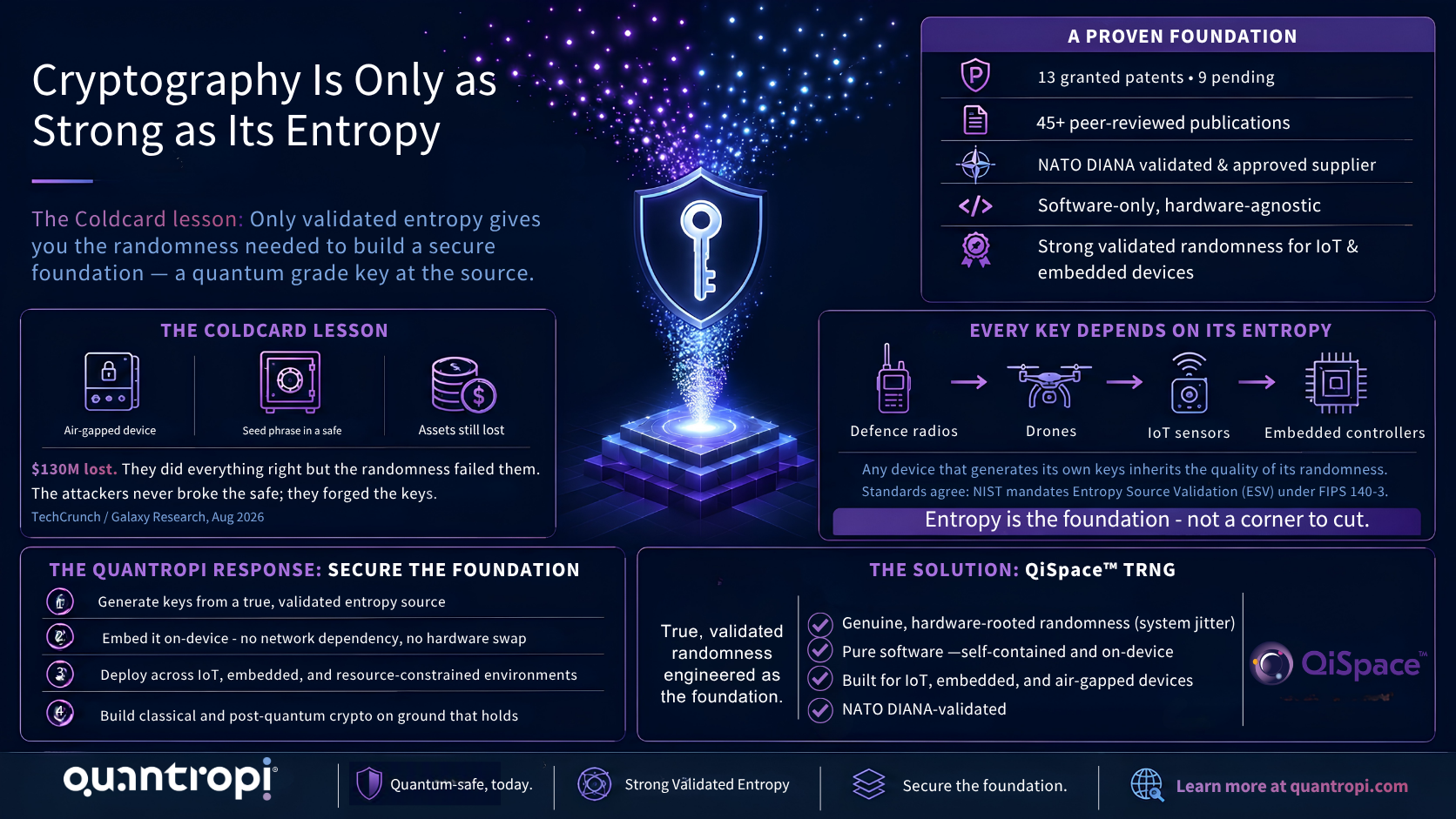
Every cryptographic system rests on one invisible foundation: the quality of its randomness. When randomness is truly unpredictable, keys are unguessable, and the system holds. When it is not, key length, air-gapping, operational discipline, and strong algorithms cannot compensate for weak entropy. The Coldcard thefts showed how owners who followed best practices still lost assets over $130M because the entropy used to generate their keys was predictable.
What is entropy in cryptography, and why does it matter?
Entropy — genuine, unpredictable randomness — is the material used to create cryptographic keys. A strong algorithm operating on weak randomness is like a bank vault with a world-class steel door and a skeleton key for the lock: the strength of the door is irrelevant if a robber can easily copy the key.
That is why entropy quality belongs at the center of any serious security architecture. It determines whether a key, seed phrase, nonce, or cryptographic secret can be feasibly reproduced by an attacker. When entropy comes from a tested and validated source that produces random numbers that can not be predicted, calculated, or guessed, then the attacker has no means to succeed. When it is predictable, constrained, or poorly implemented, the system inherits a weakness before encryption, authentication, or key storage even begins.
Why did the Coldcard wallet hack happen?
The Coldcard case is instructive because the victims followed best practices. They used offline hardware wallets, stored seed phrases in physical safes, and kept their devices off the internet. By every operational measure, they did everything right. They lost their assets anyway.
The cause was a flaw in how the wallet firmware generated randomness: a predictable fallback path produced seed phrases that could be guessed. Once attackers understood the vulnerable process, they could brute-force candidate seed phrases and identify wallets they controlled.
Put plainly: the attackers never broke into the safe. They learned to forge the keys. That is the lesson. The trusted security perimeter — air-gapping, physical storage, and operational discipline — was not the weak point. The weak point sat upstream, in the randomness that created the keys. Any device that generates keys, including defence radios, drones, IoT sensors, or embedded controllers (eg., power grids, manufacturing, automobiles), carries the same dependency.
The Cryptographic Standards Already Mandate Entropy Source Validation
The Coldcard incident is consumer-device proof of a principle standards bodies already enforce at the institutional level: entropy validation is not optional. NIST mandates Entropy Source Validation (ESV) for cryptographic applications under FIPS 140-3 Implementation Guidance (IG), requiring the randomness feeding a cryptographic module to be independently validated. The point sharpens in post-quantum cryptography. The new NIST post-quantum standards — FIPS 203 (ML-KEM) for key encapsulation and FIPS 204 (ML-DSA) for digital signatures — require more raw entropy for key generation than the classic encryption algorithms they are intended to replace.
But post-quantum modules without a valid ESV certificate do not deliver their quantum-safe guarantee. A post-quantum algorithm seeded by unvalidated entropy inherits the weakness of that entropy source. Modern quantum-safe algorithms are necessary, but validated entropy is the foundation their guarantee stands on. It is not an add-on to post-quantum security; it is the condition that allows the promise to hold.
How does Quantropi deliver true, validated randomness?
Quantropi’s approach begins with SEQUR™, which combines the raw electrical noise generated by computer systems with quantum mathematics to deliver a “true random number generator”. The TRNG brings genuine, high-quality randomness to resource-constrained IoT and embedded environments, where predictable fallbacks have historically crept in, with a footprint suited to devices that have little room to spare.
Proof Points That Matter
Quantropi delivers validated, deployment-ready capability for securing the foundation of cryptographic security:
- QiSpace™ TRNG is designed for resource-constrained and IoT/embedded environments.
- Quantropi is software-only, hardware-agnostic, and deployable on existing infrastructure.
- Quantropi is a NATO DIANA validated innovator and NATO-approved supplier.
- Its work is supported by 13 granted patents, 9 additional pending patents, and 45+ peer-reviewed publications.
Frequently asked questions
The reported thefts stemmed from a predictable RNG fallback involved in seed generation. Attackers could generate and test likely seed phrases at scale without accessing the victim’s device, safe, or internet connection. The failure was in the entropy, not in the users’ operational security.
A pseudorandom number generator (PRNG) produces values through a deterministic process based on an initial seed. Its security depends on that seed and implementation remaining unpredictable. A true random number generator (TRNG) derives randomness from a non-deterministic physical source, making it suited to generating cryptographic secrets when properly designed and validated.
Entropy Source Validation (ESV) verifies that a cryptographic entropy source meets required security requirements. NIST mandates ESV under FIPS 140-3 Implementation Guidance (IG) because every cryptographic key and operation depends on the quality of the randomness used to create it. Unvalidated randomness is a common and catastrophic point of failure.
No. FIPS 203, ML-KEM for key encapsulation, and FIPS 204, ML-DSA for digital signatures, do not deliver their quantum-safe guarantee without a valid ESV certificate. A module seeded by unvalidated entropy inherits the weakness of that source, so validated entropy is foundational to post-quantum security, not an add-on.
Quantropi delivers strong entropy through QiSpace™ TRNG for resource-constrained and embedded environments. This software-based, hardware-agnostic capabilities help organizations establish the trustworthy entropy foundation required for credible classical and post-quantum cryptography on existing infrastructure.
Who leads quantum-secure entropy, and where does it go from here?
The organizations that lead the next decade of secure communications will treat entropy as foundational engineering today. Entropy deserves the same scrutiny as algorithms, key management, device hardening, and standards compliance. The systems that endure will validate their randomness, meet the standards that govern it, and build post-quantum readiness on ground that will hold.
The lesson from Coldcard is not to retreat from cryptography or add more physical protection. It is to engineer the foundation correctly from the start. Quantropi makes that foundation available to defence, government, and enterprise builders as a standard: true, validated randomness by design, built for systems where cryptographic assurance cannot be left to chance.
Explore how QiSpace™ TRNG helps establish a stronger entropy foundation for embedded, IoT, and resource-constrained environments.